I wrote this essay about the politics of Todd Phillips’s Joker almost five years ago, and posted it to my Facebook page. That was a turning point in my decision to start this site. It wasn’t the first time I’d posted lengthy and detailed thoughts about a film and its politics, but I worked especially hard on that one, as if it were being published. I found myself wishing it could be, so that I could share a link and have hope of more than 30 people reading it.
In fact I’d been published numerous times before that, so this was not a new concept. But while I’d managed to cobble together a little part-time freelance writing career, sometimes for well-known publications like the Guardian and SBS Australia, I found that my writing about culture was becoming more expansive and more politically radical in ways that made it difficult to pitch to editors. Most outlets want short sharp snappy ideas to cut through the fog of the attention economy; I couldn’t imagine one that would bite on my obsessive Marxist deep dives into Star Wars or superhero flicks. Meanwhile the increasingly ravaged media landscape meant there were fewer and fewer paid opportunities even as the whole game became less attractive to me.
I decided I needed a home for my expansive weirdness, and that I would have to make that home myself. Three years later here we are — and it’s turned out even better than I hoped! I actually have people out there in the far reaches of the internet reading my thoughts about Don’t Look Up and Andor and Charli XCX — more readers than I ever dreamed. The fact that I’m violating every rule of the attention economy with my obsessive long reads and still finding readers is both meaningful and funny to me (and please consider buying me a coffee if you want to support!).
I always intended to enshrine the essay about Joker here just to come full circle and to fulfil my desire to have it exist on the internet. It took a lot longer than I expected: I was always either feverishly working on another article, or busy with life stuff. Earlier this year I planned to have it up before the sequel hit cinemas, but that deadline came and went thanks to external factors (parenting, studies, genocide–life balance, etc., etc.). As it happens, Joker: Folie à Deux is widely considered an unwatchably bad and embarrassing sequel, with little in common thematically or aesthetically with the first installment, so it seems nothing was lost there.
Anyway — better late than never! Here it is (and sorry for the intro that must feel like the rambling intros on recipe blogs! I just had to commemorate that bit of history).
I’ve kept the original structure mostly intact, with some editing and revision, and I’ve added bits at the top and tail for contemporary context.
For what it’s worth this article about a film that’s five years old is filled with spoilers.
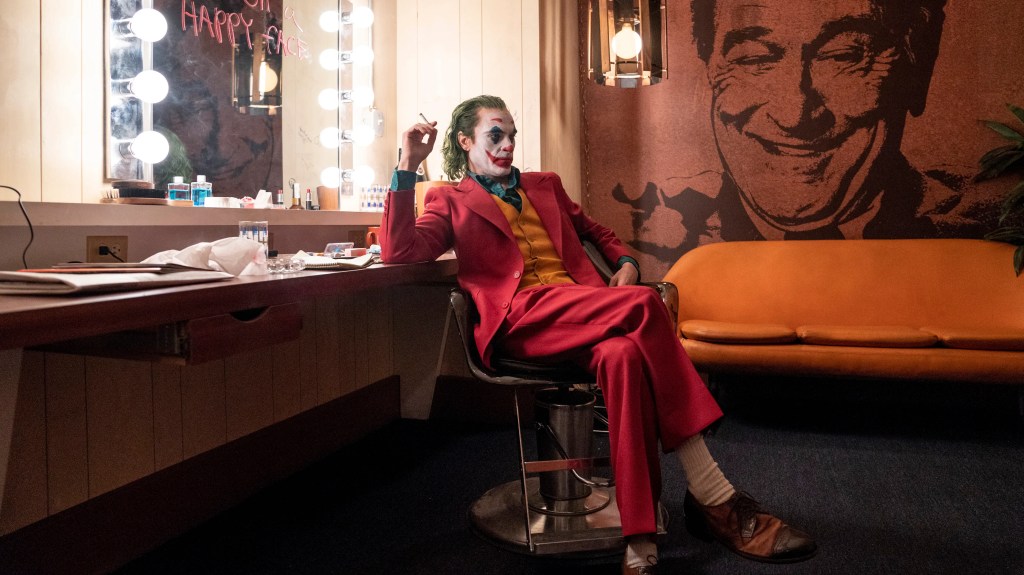
I saw Joker on its first run in 2019. I remember the screening very well because it was 10 on a Wednesday morning at the suburban cineplex near me, on a gorgeous springtime day here in Sydney. Its violence and dystopian grimdarkness were comically out of sync with my morning in every possible way — but that’s actually a standard experience for me. As a parent, weekday mornings are pretty much the only time I get to see movies for grownups.
I was taken aback by how disappointed I was. In the months before I saw it, writer/director Todd Phillips’s “serious” reimagining of the Joker origin story, though controversial in the liberal mainstream, had earned raves on the left for its relatively bold depiction of class struggle. I wasn’t exactly expecting Spartacus or Reds, but I hoped for a smart, entertaining, politically savvy departure from standard superhero fare that addressed the growing resentment towards the rich in a post-Occupy world.
I was also intrigued to hear that the vehicle for this social commentary was a pastiche of the late 70s and early 80s films of Martin Scorsese, especially Taxi Driver and The King of Comedy. Obviously wearing your Scorsese influence on your sleeve is not new, and is in fact its own kind of cliché in Hollywood more broadly, but for a DC supervillain’s origin story it sounded interesting.
Joker certainly lives up to some of those things, but in the end its politics are an incoherent mess and it becomes clear that Philipps wasn’t sure what he was doing with that aspect of it. It’s as if it’s just a mood board — as if he’s just throwing different, sometimes contradictory political and social themes in there to see what sticks. As if the anger and social instability onscreen is just there to make it feel more like Taxi Driver, not because there was any real point.
Worse, some of those themes are uncomfortably inept, especially where they relate to the depiction of women and people of color. As I’ll argue, I don’t think the film is reactionary in nature, but unfortunately it lends itself to reactionary narratives because of its clumsiness with these social themes.
This is not a full review of Joker. I’m staying focused on the politics, and more specifically unravelling some of the contradictions in its depiction of identity. Where I do discuss cinema or narrative it’s where they relate to those political and social strands in the story.
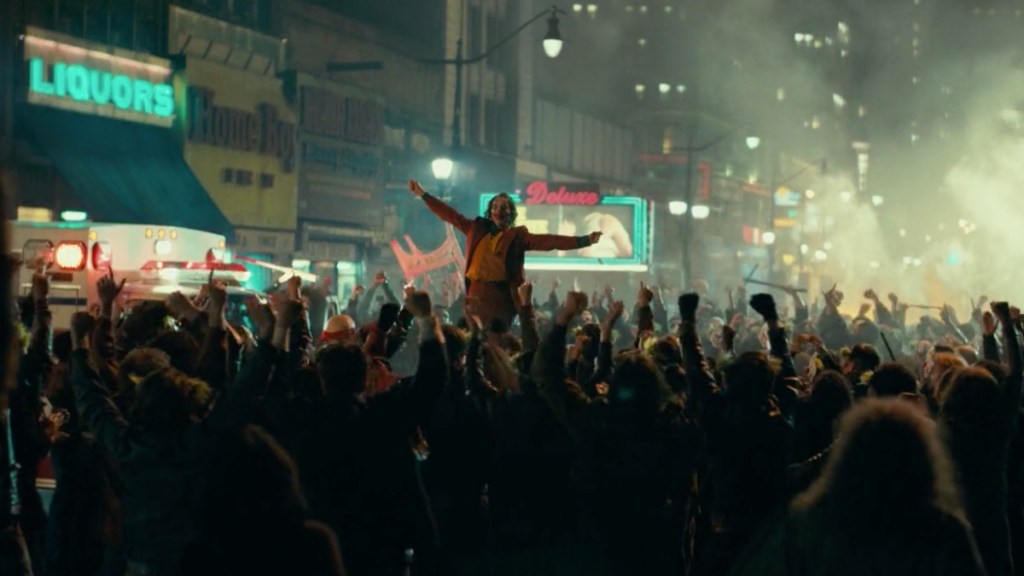
As I see it the Joker discourse, politically speaking, is divided between liberals and others on the left who abhor its depiction of white male violence, and socialists who love its class politics. Most of my political peeps whose taste in films I trust were in the latter camp, so as I said I was a little surprised to find myself in the former once I actually saw the film. But I gotta be honest.
I do appreciate Joker’s representation of class struggle and its climactic mass uprising against the rich, including Thomas Wayne and his family — that’s an amazing way to flip the Batman mythos on its head. And I think the reason so many on the left have taken to this film is you simply don’t see class politics this raw in a Hollywood film very often anymore, not since the reactionary backlash of the Reagan years and the dawn of neoliberalism, with its hyperfocus on individualism. I think it’s not a coincidence that Joker is set in 1981, the year Reagan took office, and calls back to the cinema of that era.
I won’t go into great detail about the depiction of class struggle in the film, because it’s something we can all agree on and I want to focus elsewhere. My comrade Nathaniel Flakin does a good job of tackling the film’s class politics in his positive review at Left Voice:
Joker will make any working-class viewer giddy about the prospect of beating that proto-fascist Batman. We had always heard that Bruce Wayne’s father was killed in a robbery—what if, instead, it was an act of revenge for his years of exploiting Gotham’s workers?
In other ways, too, Joker turns the reactionary narrative of the Batman franchise on its head. Even though Arthur Fleck ends up committing horrible crimes, it’s clear he was not born as a criminal, but rather driven insane by a criminal system. The film shows him, at least in these early phases, inspiring broad masses to fight back against their oppression.
The thing is, I don’t think the film’s lively class politics can be viewed in isolation from its many other flaws. Joker gets very muddled when it comes to dealing with its antihero’s motivations and goals, with some unfortunate results, specifically with regards to violence against women.
I don’t agree that Joker is a crypto-fascist film, or an incel film, or that producing or releasing it was an irresponsible act. I think some of the people who claimed those things upon its release didn’t actually see it.
But at the same time I’m just not that cool with some of the awful things that happen onscreen, especially in the final act. I found I couldn’t set these problematic elements aside.
It’s hardly inspiring that among Phillips’s stated reasons for making Joker is his belief that “woke culture” means it’s too hard to make comedies anymore (such as his Hangover series). Not only is this just demonstrably wrong, but the aggrieved tone is so strange. It’s as if he’s an obnoxious comedian who’s made one too many racist jokes and not a writer/director who’s come up with this thorny, confronting, dystopian film about class. It makes him appear quite confused about what he was trying to do, and I think that confusion is reflected onscreen.
It’s also telling that Phillips is notoriously anti-union (something I didn’t know when I saw the film in 2019). At a Hollywood Reporter Writers Roundtable in 2010, Phillips went off on the Writers Guild of America, with one groan-inducing quote after another: “The Whiners Guild, I call it.” “All I’ve ever gotten from the Writers Guild is fucked.” “I don’t think that unions should exist.”
I don’t know if Phillips has apologized or changed his tune in the 14 years since but it’s sus either way.
At the heart of the discussion about Joker is the divide between class politics and identity politics in era of creeping fascism and social breakdown. It’s a divide that should not even exist and is keeping us all down.
Class and identity should not be viewed as clashing issues: they condition each other under capitalism. The reason Black people suffer racism is because of their historic exploitation as an economic underclass, dating back to slavery. The two are connected. It’s a similar case with the oppression of women.
But on the broad left, class and identity are very often positioned against each other, as if it’s a zero-sum game. The result is the twin pitfalls of racial essentialism on the one hand, and class reductionism on the other. This is a serious problem that has divided the left for decades, and was heightened during the first Trump administration. Since I’m editing this article for publication as Trump is set to take office once again, it’s as if five years haven’t passed at all.
An example of this divide in criticism of Joker is this commentary in The Root that mocks the film’s portrayal of “economic anxiety.” That phrase is often employed by liberals to conflate the exaggerated anxiety of middle-class Trump supporters with the genuine suffering of the white working class, and therefore to dismiss the latter in an antisolidaristic way.
The entire working class suffers under the endless crises of capitalism in recent years, including white people in places like Appalachia, where life expectancy is declining and 20% of children live in poverty. If we can’t agree that’s something that needs addressing, we’re never going to get anywhere. In her 2016 book From #BlackLivesMatter to Black Liberation, Keeanga Yahmatta-Taylor wrote poignantly about how declining standards for white workers should be a basis of solidarity with Black folks. The struggle for racial justice is the struggle for the working class and against capitalism.
But at the same time, there’s a kernel of truth in The Root’s criticism; “white economic anxiety” is weaponized by the racist right wing and especially by Trump as a way to appeal to increasingly desperate and angry white workers — and they get away with it because liberal politicians like Joe Biden refuse to address the problem. This is a dangerous trend. This is how you get fascism.
All this is why I don’t think a film as muddled as Joker is really the best place to start addressing class for a mass audience. Its heart may be in the right place, but if it can’t get oppression right, no wonder some people mistake it for a fascist or an incel film.
I just want to go through some of the film’s depictions of race and gender that could be considered disturbing or unfair. Let’s look at each case, and see what the film is trying to tell us:
- The protagonist, Arthur Fleck (Joaquin Phoenix), is beaten by a group of brown youths (coded as Puerto Rican, but it’s unspecified) at the start of the film. As even Flakin, a fan of the film, admits in his Left Voice review, this plays into some awful tropes about white victims of Black and immigrant crime.
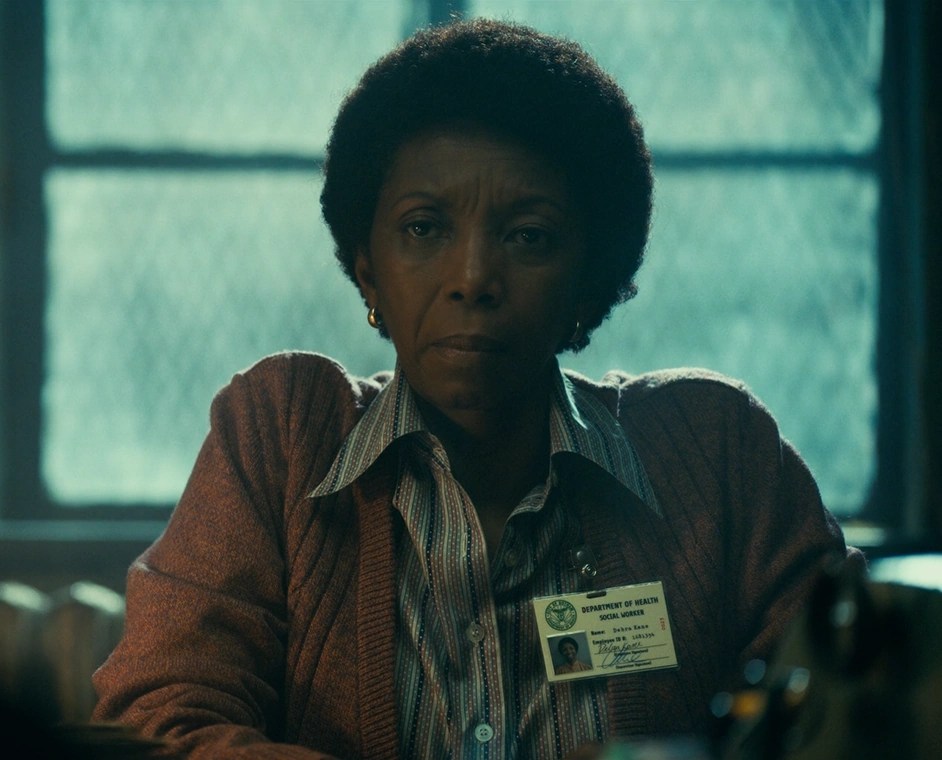
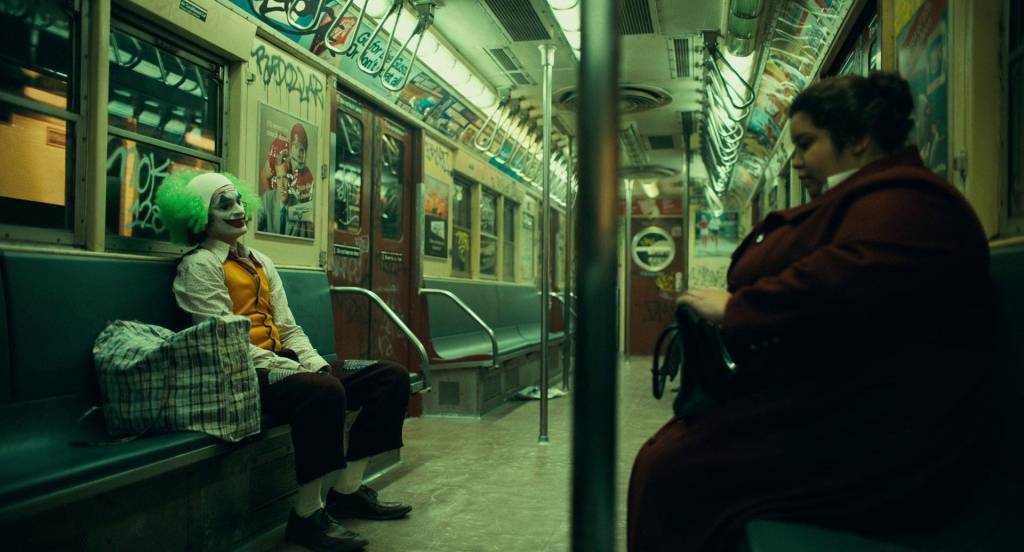
- Arthur is shown as misunderstood or disregarded by a number of Black characters, including his social worker Debra Kane (Sharon Washington), in a way that might play into white men’s fears about losing their place in society.
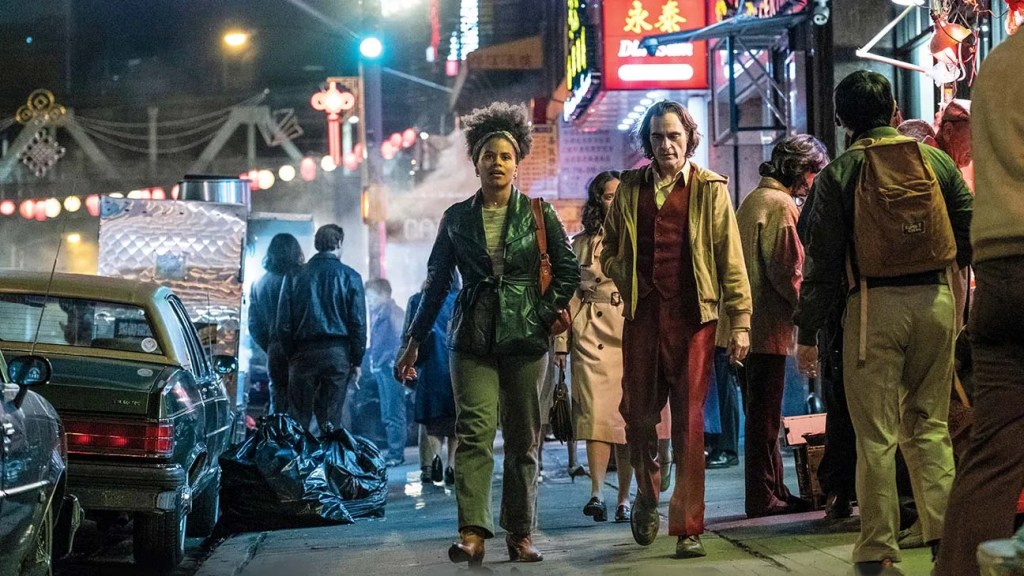
- Arthur stalks his Black neighbor Sophie (played by the great Zazie Beetz of Atlanta; I’ve often wondered if Beetz questions being in this film). Sophie rather bizarrely assents to Arthur’s creepy advances and the two start a romantic relationship, but of course we soon discover that part was all a fantasy.
(Jenny Nicholson has the best take on this: “Dude, I promise you, every woman in the theater knew it was fake as soon as she agreed to a first date where she went to watch him do standup comedy at an open-mic night.”) - In the most disturbing scenes in the film, Arthur murders two women: his mother (Frances Conroy), and, at the very end, a Black woman psychiatrist in Arkham Asylum (April Grace).
Now let’s look at some things that may mitigate or justify these story elements. Phillips is certainly trying to be nuanced and honest about these issues, if sometimes unsuccessfully:
- It’s not racist or misogynist to depict racism or misogyny honestly. Arthur inhabits a very fucked-up, unequal society (a dystopian comic-book version of early-80s New York), and Phillips does a good job portraying its many tensions. It just makes sense on a human level that Arthur might be a typically clueless white guy and stumble into a conflict with a justifiably suspicious Black woman on the bus thanks to his mental-health issues. Anyone who’s ever commuted in New York can relate to this uncomfortable dynamic.
- Arthur downplays the beating he took from the hooligans when a racist co-worker tries to egg him on about it, offering us a clue that Arthur, in all his confusion, doesn’t accept or is trying to navigate his way out of the racist assumptions of society.
This resonates for me: I was mugged by two Black men in Brooklyn one night in 1994; they told me they were going to stab me and kill me, I think just to scare me and more easily subdue me, before ultimately letting me go. It was really traumatizing and for months afterward I suffered PTSD. During that time, I worked hard to interrogate my reactions to keep from making racist judgments about every Black guy I saw on the street at night. Eventually the PTSD went away and I tried to look at it as a lesson about society.
It’s not racist to merely report that you were the victim of Black crime as an individual. But the fact is that racist politicians and media rely on the population living in fear of Black crime, and it is racist for the media to relentlessly highlight Black crime, or for movies to feature it uncritically. - Ultimately Arthur kills the same co-worker for betraying him to the police, and I think the viewer is meant to find some satisfaction in it because he’s killed a racist.
- In one of the most inspiring scenes, Arthur violently punishes a group of Wall Street bros who sexually harass a woman on the subway, momentarily encouraging the viewer to see Arthur as some kind of crusader against rape culture, as well as the ruling class.
- Regarding the stalking of Sophie, and the attendant fantasy: if Joker truly was an incel film, wouldn’t the romance have been a straightforward part of the plot and shown in a redemptive light? When it’s revealed to be a twisted dream, it makes the viewer question the whole process of male fantasy, and we sympathize more with Sophie than with Arthur. That’s a good thing — though it sure is queasy getting to that point.
So far so good right? This is why some of the more thoughtful defenders of the film have a case.
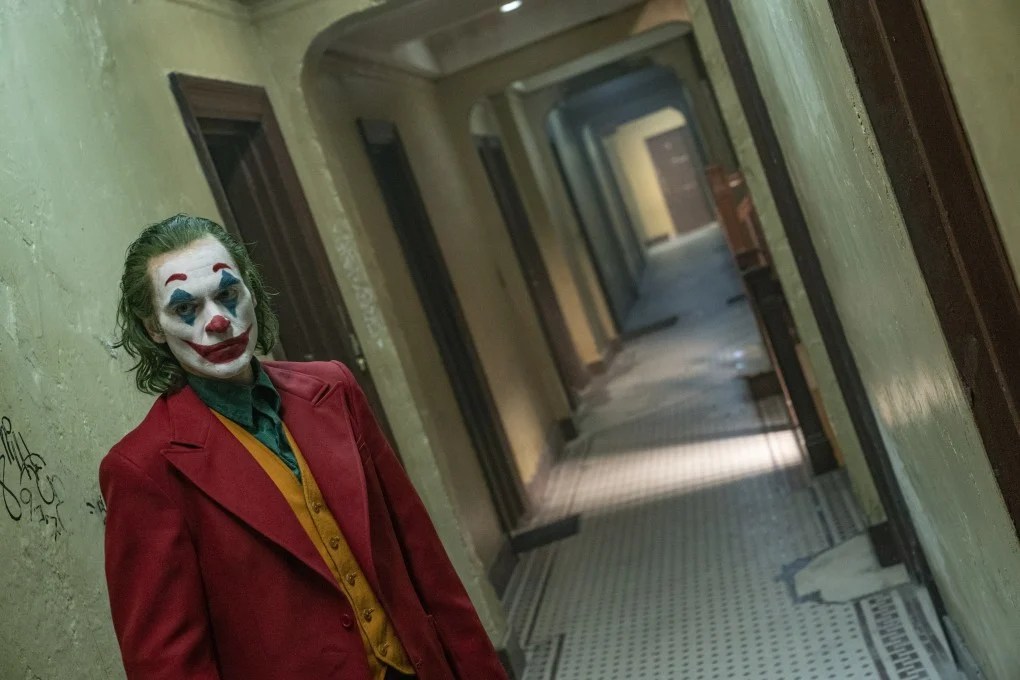
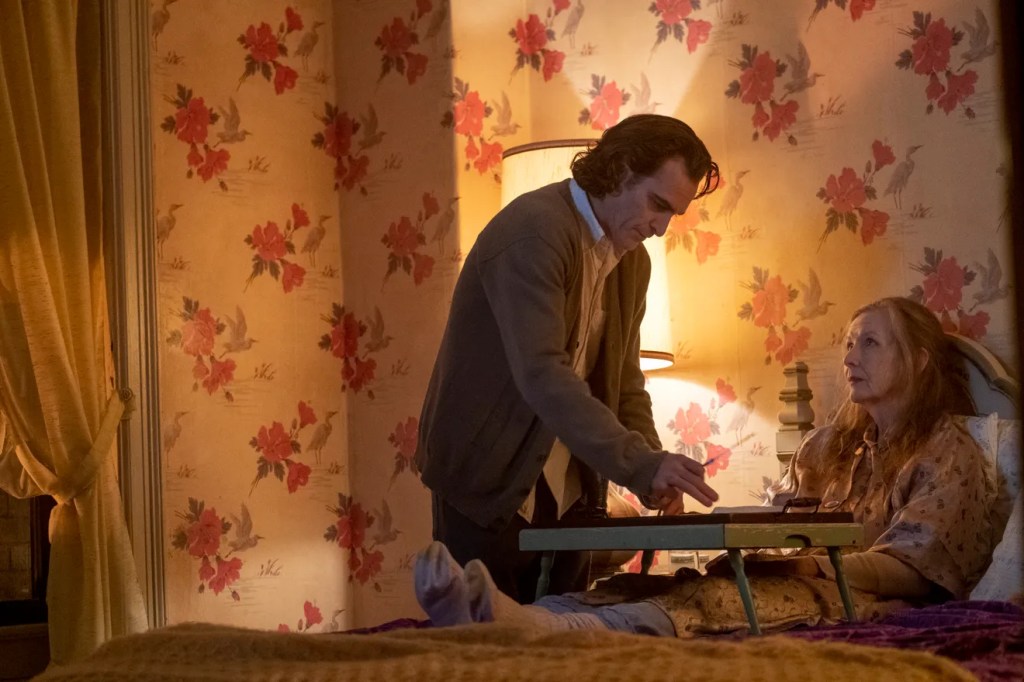
And yet. Are we supposed to think it’s okay that Arthur murders his mother because he was abused as a child by his stepfather? I’m not sure what Phillips meant for us to think, but either way the scene really distressed me and I couldn’t really recover from it.
And in the very last scene of the film he murders the psychiatrist, a Black woman, and this is presented in a tragicomic light, with “Send in the Clowns” by Frank Sinatra blaring on the soundtrack as Arthur runs away from the asylum staff like Bugs Bunny. That tipped it over the edge for me. I just couldn’t hang and it left me feeling reluctant to celebrate the film. The contradictions are too jarring.
So where does this film’s heart lie? With the anti-misogynist confrontation of the Wall Street bros, or with the sensationalist murder of the Black woman psychiatrist? I don’t think Phillips has a convincing answer to this question.
Mind you, I don’t think a film needs to be a political manifesto and get everything right. It’s okay to depict confusion and chaos, and it’s okay to be politically evolving and not have all the answers. Black Panther is a politically muddled film too, albeit in a much less violent and disturbing way. I love that film and don’t have a problem with these contradictions at all. I wrote at length about Barbie’s contradictions and still loved it.
And the fact that a film might be embraced by incels or various other creeps against the wishes of its makers doesn’t mean it’s not worthwhile, or we’d have to dismiss The Matrix. Joker isn’t a hundredth as good as The Matrix, but just saying it’s not grounds for dismissal if it’s misunderstood by assholes.
In the end, I think Joker is not misogynist at its core; as I said, in some ways it explicitly opposes misogyny. But still, I think it stumbles into uncomfortable proximity to misogyny — yes, rather irresponsibly — because it’s trying too hard to be edgy in its character study of a violently disturbed man with mommy issues.
This is a longer conversation, but I’ve never liked the whole Arkham Asylum grimdarkness mode in the Batman mythos that’s trying so hard to be cRaZy.
In fact, I’m really over the whole Batman mythos in general, as much as it meant to me when I was growing up. Though this film goes a long way towards addressing the social problems of that mythos, and it’s very awesome that it makes the Waynes into villains, it still has this typical obsession with violent mental illness that’s not only disturbing but just not very aesthetically appealing to me.
I’m also pretty much over the Scorsese and Stanley Kubrick films (the latter including A Clockwork Orange and, of course, The Shining) that are so heavily referenced here, many of which are also about white male violence and mental illness. They meant a lot to me when I was a 20-year-old film student, I still find them objectively brilliant, and I still regard them as a big influence. But after all these years I just find the sway they hold over pop culture — especially the corners of pop culture dominated by young men — pretty tiresome, and I don’t find myself wanting to revisit them often. There are so many other classic films to check out that aren’t about violent men.
It irritates me that, with the thankful exception of Black Panther, other comic-book and superhero films are not taken as seriously as this very splashy, violent, self-serious film. As I’ve often mentioned I hate the false dichotomy between genre pictures and serious cinema; Joker obviously benefits from playing up the “serious cinema” angle in some ways I find very predictable and clichéd.
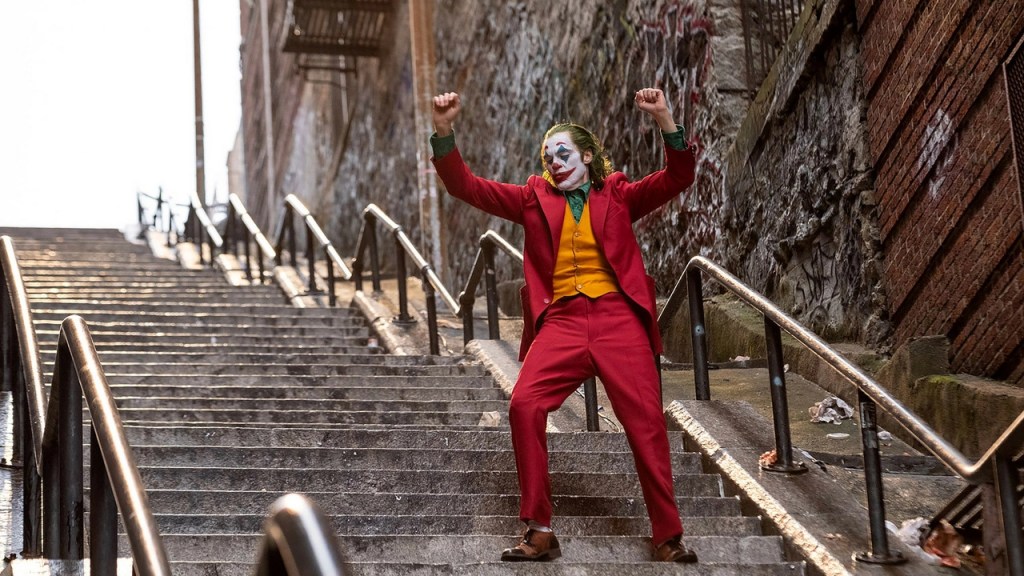
As a side note, it’s unfortunate and annoying that the film’s most iconic moment is set to the incredibly played-out “Rock and Roll Part 2” by Gary Glitter, which you never need to hear again if you’ve been to more than three sporting events in the last 40 years. That was a lame choice for such an important scene.
This is how I concluded my original post about the film: Still, despite all this I think it’s an interesting film, and I would recommend it to anyone who could both stomach the violence and remain analytical. It’s a film that’s worth our attention.
I don’t know if I would be even this generous about Joker anymore. In the past five years I’ve had little desire to rewatch it — I thought about it as I was editing this piece and call me lazy but I decided I couldn’t be bothered. News of the apparently dreadful sequel, hearing about Phillips’s dipshit anti-union attitudes, and the increasing dominance of the incel right wing (the “manosphere”) in every online cultural space have severely dampened whatever tepid appeal it had for me.
As she often does, Jenny Nicholson crystallized some of my misgivings with Joker more broadly with her video about the film, which she posted around the time it came out but which I only saw a year ago, long after I first drafted this essay. It’s absolutely worth 34 minutes of your time. In her typical fashion, she starts out lowkey, rambling and making snarky jokes (while dressed like Arthur Fleck, which is so hilarious and cute), before she becomes more impassioned and really starts cooking. In the end her critique of the film is more incisive and thoughtful than any other critic’s.
Nicholson argues that Joker fails as a character study, the main thing it purports to do, because it dishonestly hedges its bets with Arthur’s mental illness and seems to invent new motivations for him with every scene.
I get that the Joker is some kind of crazy supervillain so he doesn’t have to do things that make sense to us or that we approve of, but they have to at least make some kind of internal sense, and if they don’t, then he’s not a good character to base a movie around.
She singles out the ugly climactic scene in which Arthur shoots and kills talk-show host Murray Franklin (Robert De Niro) — in particular for the suddenly coherent Arthur’s heavyhanded speech that suspiciously echoes Phillips’s real-life complaints about “wokeness”: “Comedy is subjective, Murray. Isn’t what they say? The system that knows so much decides what’s right or wrong. The same way you decide what’s funny or not.”
As Nicholson says:
You can’t have it both ways. You can’t make a movie about a mentally ill man’s tragic descent into further madness, and then also have an ending where he gives a big coherent speech where he’s a mouthpiece for you, the writer-director, about how nobody wanted a fourth Hangover movie.
She says this narrative flaw is the reason for the film’s murky politics and “irresponsibly vague” view of men’s violence. Arthur seems pleased with having inspired riots against the ruling class, but later he says he’s not political — which is it? Nicholson thinks Phillips doesn’t actually know:
What was the theme? What was it about? It sure presents itself as though it has something to say and it half-says many things, but it doesn’t commit to any of them…
The movie gives so many of its characters statements that sound like they’re the theme about what’s wrong with society, what needs to be fixed, but then it can just as easily back away from any of them by being like, well, that wasn’t the good guy, or that character’s crazy, but then it’s like, say something…
You’re affording yourself enough deniability that if any part of the movie doesn’t make sense you can be like, well it wasn’t supposed to! But then why did you make your movie? It’s disingenuous to claim that it doesn’t have any point, because you made it for some reason, but you’re just afraid to commit to what it is.
There are worse crimes being committed in the name of cinema: I might take Joker over the truly misogynist shit that Quentin Tarantino’s been spewing lately; and I would definitely take it over some of the reactionary dreck pushed by liberal Hollywood — for example Gary Oldman or Meryl Streep working overtime to convince us that Winston Churchill or Margaret Thatcher were laudable human beings.
I just think that we’re so starved for class politics onscreen it’s led some of us to overrate Joker.
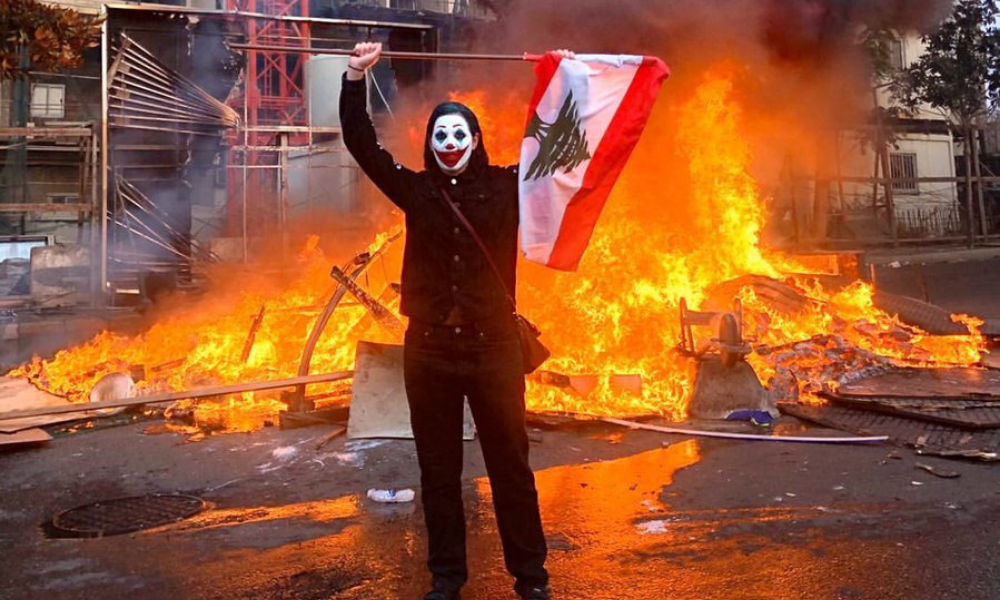
Another thing: I think it’s quite cool that protesters in Lebanon, Chile, Hong Kong and elsewhere wore Joker masks and makeup during the wave of protests that swept those regions in late 2019 after the film was released. It’s wonderful that Joker’s ideas about class struggle have spilled over into real life. But I thought the use of the Guy Fawkes masks during Occupy Wall Street in 2011 was cool too, and yet V for Vendetta is a very overrated film.
Like what you read and want to support? Consider buying me a coffee! You can also subscribe below, and be sure to share this article!
 Under the Paving Stones